 Mike Rann has proposed a set of protection areas for the northern Flinders Ranges, including the Arkaroola Sanctuary and Mount Gee. See below for the full transcript of his statement to Parliament of today. And here for the document 'Seeking a Balance'
 While it will take a little time to work through the full implications of exactly what's been proposed my first reaction is easy: 'it's not enough, Mike!'
If you consult the map (see image below for link to the larger version) there's a rather remarkable gap - kind of an exposed midriff - between the dense cluster of restricted access sectors in the north and another cluster in the south of the Arkaroola Sanctuary.
 Now, you probably won't be astonished to learn that this patchy band just happens to coincide with the putative uranium hot-zone and Marathon's exploration lease.
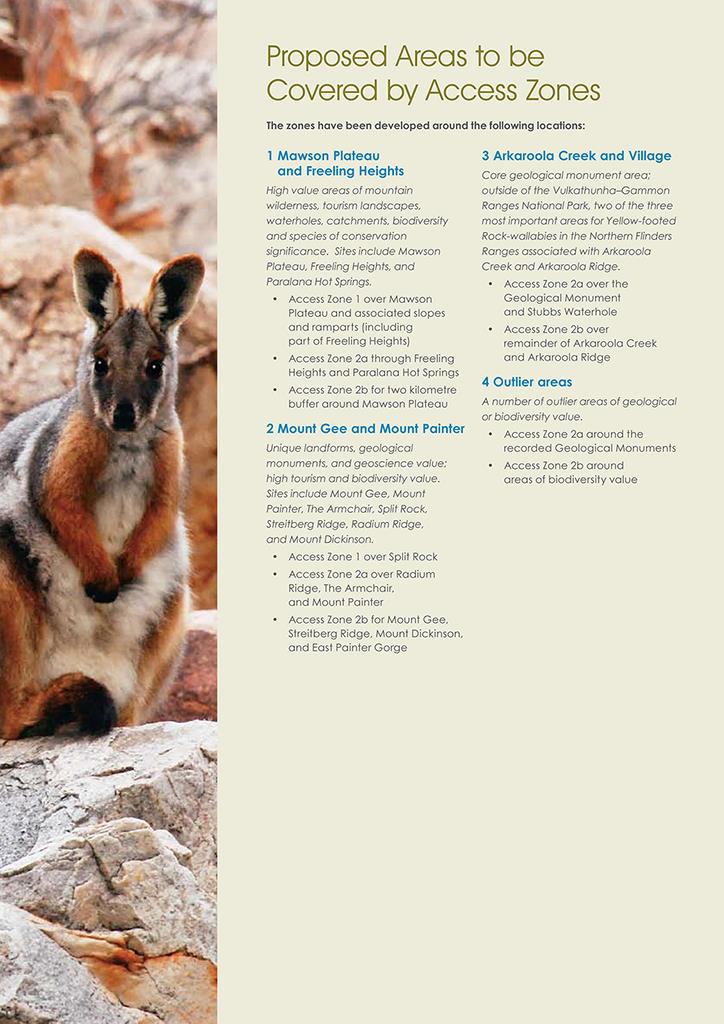
Some preliminary observations; Mount Gee is clearly shown to be within Zone 2a (the second-highest level of protection afforded - no drilling access is allowed) in the map on page 15 (see at right), and yet is described in the text on page 16 as being in Zone 2b (where drilling is allowed - see below). In the circumstances this really is a remarkable error. So which Zone is it really in, Mike?
do they read their own laws?
Even more amazingly, mining 'infrastructure' may now be permitted to be installed in Zone 2b -
Infrastructure may be permitted within the zone on a case-by-case basis provided it protects identified values
 To date Marathon has acknowledged accepting that it will have to tunnel in under the ranges from outside to access the resource, and that it wouldn't be establishing any entrance tunnels for shafts, declines or similar locally, so the Rann Govt. has apparently gone backwards on this point!
 In fact, the government is behaving as though laws that are inconvenient for its purposes simply don't exist! Has anyone in this government actually read the Environmental Class A Zone provisions that already apply to the Northern Flinders Ranges under the Planning Act of 1993?
No-one - not Marathon, not Heathgate / Alliance, not even the Government itself - can build any such 'infrastructure' anywhere in the ranges - even in the proposed 'open - slather' zones. It's worth quoting from this legislation;
Objective 1: The conservation of the natural character and environment of the area.
Land in the area is of extremely high landscape, wilderness, environmental and scientific value. These qualities make it an attractive natural environment containing little evidence of human impact. New structures need to be restricted to shelters and rainwater storage for walkers and persons on horseback and to structures ancillary and adjacent to existing buildings....
Conservation of the environment and landscape is the paramount aim and consideration in the Environmental Class A Zone...
No new tracks (as distinct from roads) should be constructed and the use of existing tracks by vehicles also needs to be restricted...
and while we're quoting this 'inconvenient' legislation;
No mining operations should take place in the Environmental Class A Zone except where:
(a) the deposits are of such paramount significance that all other environment, heritage or conservation considerations may be overridden;
(b) the exploitation of the deposits is in the National or State interest;
(c) investigations have shown that alternative deposits are not available on other land in the locality outside the zone...
Alliance's Beverly 4 Mile ISL uranium mining operation lies only a few kilometres from Marathon's lease's eastern boundary. Roxby Downs is the largest uranium mine in the world, and SA has 4 other mines running or approved. So much for 'paramount significance' 'National interest' and 'alternative deposits are not available'!
It's ridiculous - nobody needs the uranium under the Arkaroola Sanctuary for any reason better than their own potential personal enrichment. Existing legislation was developed specifically to protect the character of the ranges. And yet the Rann government has proceeded to divvy up the northern Flinders as though they owned the place!
more steps back!
And speaking of going backwards rather than forwards; Mineral Resources Development Minister Paul Holloway's previous Media Release stated categorically that the Department for Environment and Heritage would be signing off on all potential Marathon Exploration activities within their lease -
These conditions include the requirement for both the Director of Mines and Chief Executive of the Department of Evironment and Heritage to jointly approve all exploration activities [emphasis in original]
And yet there are areas within Marathon's lease as depicted on Mike Rann's new map that are not designated as requiring joint management with the DEH!
To be logically consistent all sectors of EL 3258 (or it's successor!) must at a minimum be assigned within Zone 2b, where the DEH's approval is a requirement for exploration activities. Instead large chunks are assigned to 'access all areas' standard-mining-lease zones with only the Minerals Department approving any exploration. This is blatantly contradictory.
Lookout, Sillers!
Incredibly, Sillers Lookout, the iconic area that is the outward terminus for the Ridgetop Tour also sits in this 'open slather' zone.
Yes, despite a dramatic photo of the Lookout adorning the page 2 and 3 frontispiece of the government's own document. And despite this major Tourism drawcard being the very image that most people are likely to call to mind when they think of Arkaroola! Mr. Rann, this is 'asleep at the wheel' stuff!
But, you see, Sillers Lookout has the misfortune to be located in the 'exposed midriff' of the Sanctuary.
No doubt much more discussion will ensue. The public has until December 19th to comment on this proposed legislation, which is described specifically thus; 'the area zoned in this document is the minimum area for protection'.
I suggest we tell mike Rann we want more. Much more.
NORTHERN FLINDERS RANGES
The Hon. M.D. RANN (Ramsay—Premier, Minister for Economic Development, Minister for Social Inclusion, Minister for the Arts, Minister for Sustainability and Climate Change) (14:11): I seek leave to make another ministerial statement, and I apologise for the length.
Leave granted.
The Hon. M.D. RANN: The future of the Northern Flinders Ranges, including the Arkaroola Wilderness Sanctuary, requires a careful balance between minerals and energy exploration and preservation of the unique environmental beauty of this world-class tourist area. Resource companies need both certainty and clarity when making decisions about their high risk long-life investments. While the Northern Flinders Ranges has been explored for decades, it has long been recognised by the industry and government that iconic areas in the Northern Flinders need clear and appropriate levels of protection. I am announcing today that the South Australian government is moving to ensure this balance is achieved by adopting a Northern Flinders Environmental Management Framework and putting it out for public consultation for the next eight weeks.
Despite the impact of the global financial downturn over the past year, mining continues to be a foundation stone of South Australia's ongoing economic growth and prosperity. A key reason for the huge increase in minerals exploration in our state over recent years is the state government's Plan for Accelerating Exploration (or the PACE program, as it is better known). This $31 million investment that we launched in 2004, in partnership with the resources industry, is a key part of our strategy to diversify the economy of our state in order to increase economic growth. Never has any scheme delivered better bang for buck than the PACE scheme in mining. PACE has resulted in—
Members interjecting:
The Hon. M.D. RANN: Oh, they are still going on about tasers. They spend all their time tasering each other! PACE has resulted in an unprecedented boost in mineral exploration activity, which—
Mr Williams interjecting:
The SPEAKER: Order! The Premier will take his seat. The member for MacKillop.
Mr WILLIAMS: It is the convention of the house, when a minister obtains leave to make a ministerial statement, that they supply other members with a copy of it.
The Hon. M.D. RANN: I have got them here.
Members interjecting:
The Hon. M.D. RANN: No, I want him to read it, because he will see that there was $30 million a year in exploration under the Liberals and there was $355 million a year in 2007-08. So, that is the difference. PACE has resulted in an unprecedented boost in minerals exploration activity, which grew from around $30 million a year at the start of this decade to $355 million in the 2007-08 financial year. From a total of four operating mines when this state government came to office—
Mr Williams interjecting:
The SPEAKER: Order, the member for MacKillop!
The Hon. M.D. RANN: —South Australia is now home to 11 mines—
Mr Williams interjecting:
The SPEAKER: The member for MacKillop!
The Hon. M.D. RANN: —with that number expected to increase to 16 by the end of next year: a fourfold increase in the number of mines in this state.
In addition, we have more than 20 projects that are currently progressing through the approvals process. That growth reflects the climate of investment certainty that the government has created over the past 7½ years. But the PACE initiative is not solely about attracting exploration and investment. Among the eight themes that underpin our PACE scheme are balancing resource development with conservation and also resource development and sustainable communities.
Of course, balancing the realisation of mineral resources with the needs and sensitivities of our environment is a challenge for governments the world over. That is why the South Australia government continues to work closely with the industry to help ensure that our resources sector grows in concert, not at the expense of our natural environment.
We have shown our preparedness to act when our stringent environmental requirements are not met. The government has responded to inappropriate activities by Marathon Resources in the Flinders Ranges by imposing stringent licensing conditions and an ongoing ban on ground-disturbing activities. The company cannot drill or do anything with their licence beyond flying over the area or picking up rocks exposed on the ground for the next 12 months. In October 2010, the company will have to apply to have their licence renewed and the government will again determine what conditions will be imposed at that time.
This government has an equally strong record in protecting and enhancing our natural environment. For instance, since coming to office, we have placed about 800,000 hectares of wilderness under wilderness protection, the highest protection level we can provide. And now we get on to Arkaroola and the Northern Flinders which has been the subject of such controversy.
The Northern Flinders is an area of South Australia which has been a focus for mineral exploration since early last century and which has had high mineral prospectivity and a potential source of geothermal energy, but it is also an area of wild beauty, high conservation values and significant tourism potential. It is home to the Arkaroola Wilderness Sanctuary, a place that South Australians identify as greatly untouched wilderness. Its habitat includes plants and animals unique to the area, including the Flinders Ranges purple spotted gudgeon, the spidery wattle and the endangered yellow-footed rock wallaby. It is also a place of significant cultural value to the Adnyamathanha people who retain a living connection with their country. That is why the future of the Northern Flinders Ranges requires a careful balance between exploration and the preservation of these areas of great environmental and cultural value.
Today, I am announcing that the state government will be adopting an environmental management framework to balance the environmental and prospectivity values of the Northern Flinders Ranges. The new framework provides a sensible set of guidelines that exploration companies can use while working in the Northern Flinders. And here is the rub. Areas with particularly high conservation and tourism significance will be zoned such that no access for exploration or resource development is allowed. At the same time, environmentally and culturally important areas in the Northern Flinders Ranges such as the Mawson Plateau, Freeling Heights, Mount Gee, Mount Painter and Arkaroola Creek will be managed in a way that preserves areas of local heritage and scenic beauty for generations to come.
The framework is based upon a joint project by Primary Industries and the Department for Environment and Heritage to identify the heritage sites of the Northern Flinders Ranges. This project has established a set of management policies and zones to identify the most important environmental and landscape values. Some sites will be zoned to allow lower impact exploration, while other sites will be zoned to allow for standard exploration and mining access, but also, of course, there will be zones where there is a total, absolute prohibition.
The framework clearly provides for ongoing access to areas of high mineral prospectivity. By implementing these zones, the framework will provide the kind of certainty and clarity that resources companies require when making decisions about their high-risk, long-life investments. These management arrangements are in addition to existing protection—in addition to existing protection—under the Aboriginal Heritage Act and other relevant legislation.
The government will be seeking feedback from key stakeholders, such as the state's Chamber of Mines and Energy, traditional owners, the Wilderness Society, the owners of the Arkaroola Wilderness Sanctuary, as well as mining, exploration and other lease holders. The draft framework will also be available for broader public consultation for eight weeks, and I encourage people to have their say to make sure that we get the balance right. The final policy documents will be released by the government in early 2010. But, in conclusion, and this is the most important thing, areas with particularly high conservation and tourism significance will be zoned that no access for exploration or resource development will be allowed.


![link to the u[n]sa homepage](https://lh3.googleusercontent.com/blogger_img_proxy/AEn0k_vBIZarTCkPKultlgS_9egK0bfpXpFaGb2VioVlysInFkFXEV2uRdejWgU4-MrRX91XdOkLm9hh5xwQ5pvbn9XA-0ijwe1yhDXUJEbIkH12fLf_xMqejv0E-NRD3TCEMFN8ot0=s0-d)


![link to the u[n]sa features page](https://lh3.googleusercontent.com/blogger_img_proxy/AEn0k_v5u8Bg-NUlpL1cWCUB0IJb7meJhscun8q_VhBA2hOo7fYZeCD2-6gsv-aW5LrQ0xIz-vNkZnKUFatE5SMfc4MRC2HunGk0gjkuNF_d-s53iSzju8SvOgPYsKHeNd03KeOQD00=s0-d)
![link to the u[n]sa flinders ranges feature image pages](https://lh3.googleusercontent.com/blogger_img_proxy/AEn0k_vO1Snx8_exrwOozP74uOBqf1Ii9wMlxILU1e7qUIVCf51jEk3BCuuDsn_i5g7CS2UdVj53jFFcyphllDaOUfn1ECkm47u2Jciwt1o0B1C46uAYavW7QxfoNR0RWoOdv7bBu54zNsHvBuRtm4J7FRrfu5X1SF4=s0-d)
![link to the u[n]sa kangaroo island feature image pages](https://lh3.googleusercontent.com/blogger_img_proxy/AEn0k_u3bM3YN2_yF6Q_05JUag7_H8cNbPl2oLw_3Oaw5MIzA9XySQ3zdOCxVXZdDk-cujOba7E8b4yBVCEWYJk--cNHXvMWoL3GrDbvSDoAhc9zl1Cgmz28gFZoG9lOcdNtq3zDXA=s0-d)
![link to the u[n]sa katarapko creek / murray river np feature image pages](https://lh3.googleusercontent.com/blogger_img_proxy/AEn0k_sZouK7r5V4JRKUFGy4IhwqQGUWuESEtiBE9szufOqR9kWXK8qwxlOMB3wbr7jejDme6f56Bh9T1gTf6WKz4-Eq-1sPfp0uQLfo9um8pW11P0aHrWjyg5bddtxgqo5SnSUi1w=s0-d)


!['constellation' - wild country [national] set on flickr](https://lh3.googleusercontent.com/blogger_img_proxy/AEn0k_vReVBiw6-pYPH9zpsOxMenM_Kb5Ldzr6FzPU_c5c0KEXYCCoDW-gqdDsnOR8RT4rtPwGOsxrzflp9opMRWRCM3lyqJccLJboc35iLCGt-nf5ImvQe1poHm2ZRpsEEnwA=s0-d)

!['the bay serene' - the wild west [coast] set on flickr](https://lh3.googleusercontent.com/blogger_img_proxy/AEn0k_vJG9PIX2v-MJg9P42fkit27OwMhGi-SxrweBXTeKV0UTkMZfc_k1O3NFMTo_RZv5riGE_Fo6ISM__XGkmp6DJtZlCd2QBt022XUPCjVeGieNZcqzJwWgtvW2hlblEigcU=s0-d)


![u[n]sa journal - thanks for your time!](https://lh3.googleusercontent.com/blogger_img_proxy/AEn0k_uvm7Uyg_BFL7s29uUSltrNIexcXAMaxFS9wNqCmSMMZN2Cuy6ngNVnoI91j5Ey7zh8P6AG2GLmskhpmobMKU_v4MuwrxErspcw7l7JWpMtBIGuf2LnjMmY4HWTp7GkQlKj=s0-d "u[n]sa journal -thanks for your time!")
